India eyes Stilwell Road to tap Myanmar rare earths, challenge China
India is once again looking at a possible revival of part of the old Stillwell road built during World War II, spurred by the rare earth riches that Northern Myanmar is sitting on.
India’s move comes as global economies push to “de-risk” critical technologies, linking artificial intelligence governance with resilient supply chains and long-term economic security partnerships.





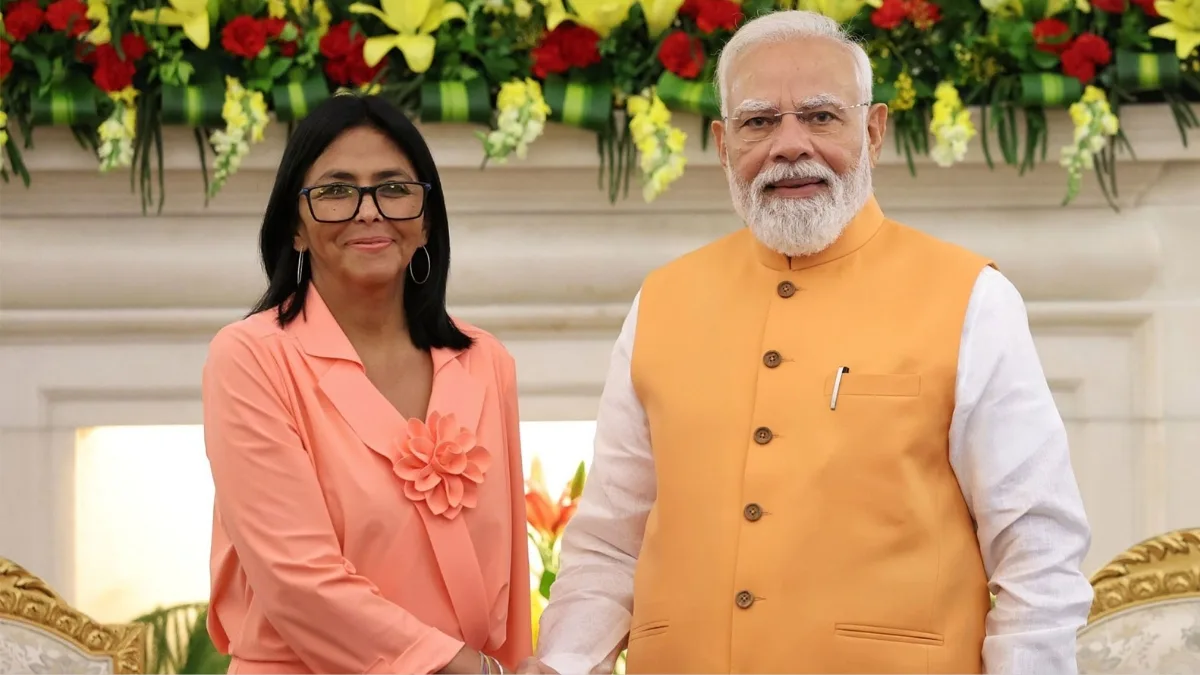
International delegates participate in discussions on AI governance and economic security at the summit. | Photo: IANS/PMO
In a significant step at the AI Impact Summit in the national capital, India is set to formally join Pax Silica, a US-led initiative focused on artificial intelligence and supply chain security, on Friday.
The decision ties India into a broader US Department of State framework that seeks to build economic security partnerships among trusted countries by linking AI development with resilient supply chains. The issue has gained urgency amid geopolitical tensions and concentration risks in critical sectors.
Advertisement
Pax Silica is described by the US State Department as its flagship effort on AI and supply chain security. The Pax Silica Declaration emphasises the need for reliable supply chains as indispensable to mutual economic security and recognises AI as a transformative force for long-term prosperity.
Advertisement
According to an official statement, the Declaration’s signatories include Israel, Japan, the UAE, Australia, Greece, Singapore, Qatar, South Korea, and the UK. The European Union, Canada, the Netherlands, the Organization for Economic Cooperation and Development and Taiwan are participating as non-signatories.
The development coincides with the visit of Under Secretary of State for Economic Affairs Jacob Helberg to India from February 20–21. The State Department said Helberg will join the US delegation to the India AI Impact Summit, led by White House Office of Science and Technology Policy Director Michael Kratsios.
During his visit, Helberg is expected to hold bilateral meetings and deliver remarks aimed at advancing US-India economic ties in emerging technologies. He will also help launch the next phase of the American AI Exports Program under the AI Action Plan, the statement said.
India’s entry into Pax Silica comes shortly after it participated in the Critical Minerals Ministerial convened earlier this month by US Secretary of State Marco Rubio.
External Affairs Minister S Jaishankar, who represented India, called for structured international cooperation to “de-risk” critical mineral supply chains, warning that “excessive concentration” poses a major global risk.
On the sidelines of the Ministerial, Jaishankar told ANI that India had extended support to the Forum on Resource, Geostrategic Engagement (FORGE), a new initiative unveiled at the inaugural Ministerial that succeeds the US-led Mineral Security Partnership.
In a post on X, he said India had underlined the importance of de-risking supply chains through structured international cooperation and highlighted initiatives such as the National Critical Minerals Mission and Rare Earth Corridors to strengthen resilience.
The India AI Impact Summit 2026, billed as the first global artificial intelligence summit to be hosted in the Global South, has convened policymakers, industry captains, scholars, and civil society voices to discuss responsible AI governance and inclusive technological growth.
Prime Minister Narendra Modi, addressing the gathering yesterday, outlined what he termed the MANAV vision for AI: “Moral and Ethical Systems, Accountable Governance, National Sovereignty, Accessible and Inclusive, Valid and Legitimate.”
“M – Moral and Ethical Systems: AI must be based on ethical guidelines, A – Accountable Governance: Transparent rules and robust oversight, N – National Sovereignty: Data belongs to its rightful owner, A – Accessible and Inclusive: AI must not be a monopoly, but a multiplier, V – Valid and Legitimate: AI must be lawful and verifiable,” he said.
Also Read: PM Modi unveils ‘MANAV’ vision for AI evolution at AI Impact Summit
The Prime Minister asserted that India’s MANAV vision would serve as a crucial link for humanity’s welfare in an AI-driven century.
At the Leaders’ Plenary Session later, he said the Summit would help shape a human-centric global ecosystem and stressed that AI must remain accessible, with Global South priorities at the centre of governance.
“Ethics in AI must be unlimited; profit must align with purpose,” he said, suggesting a trusted global data framework, transparent “glass box” safety rules and embedding human values in AI.
Advertisement